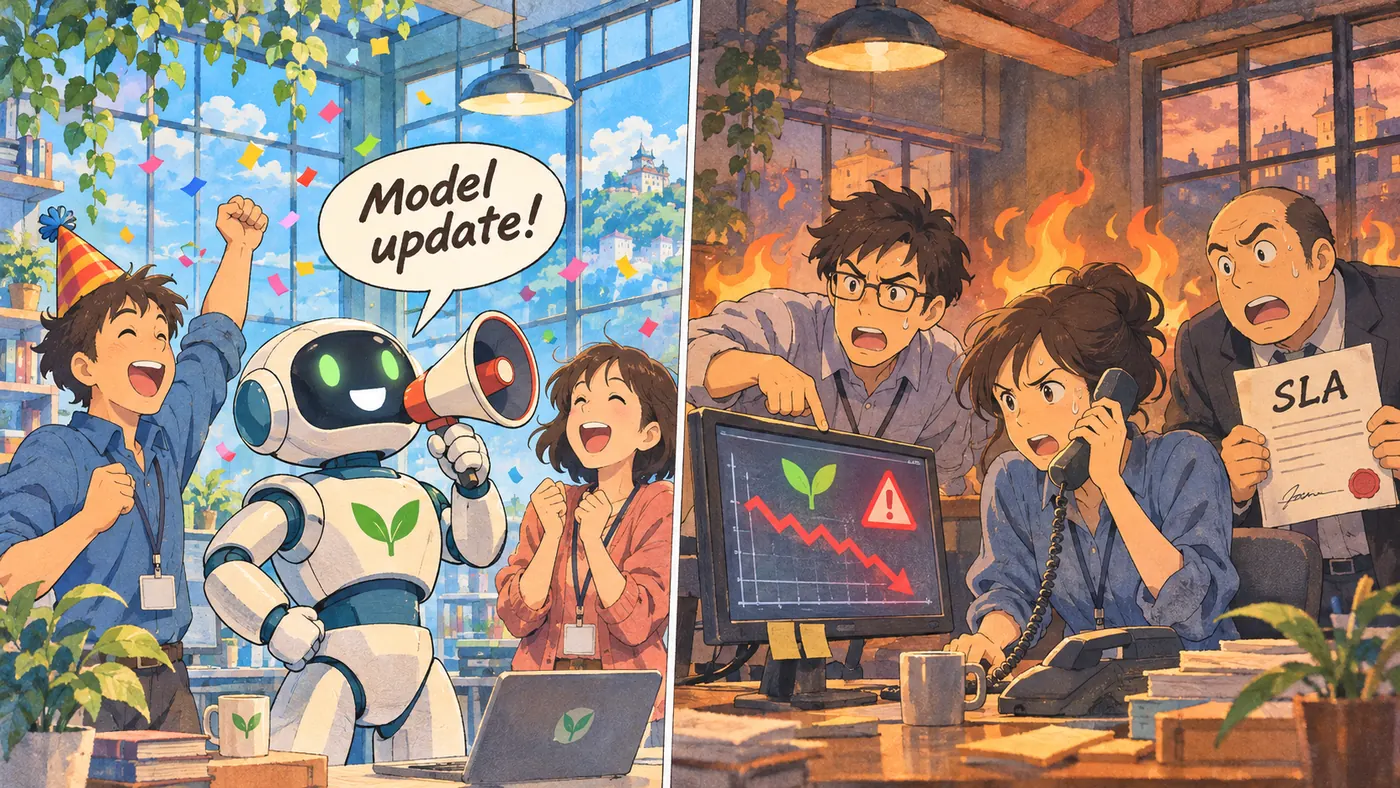
OpenAI continues its aggressive model lifecycle strategy by scheduling the sunset of GPT-4o.
If you’re using ChatGPT directly, despite the buzz, this may be a non-event. But if your business integrates models via API into a client-facing product, this is actually a big deal.
We ran into this exact issue with a client a few years ago.
Significant investment went into working with subject-matter experts to ensure that outputs generated with GPT-3.5 consistently met strict quality expectations. After extensive testing, we were confident in the results.
Then GPT-4 arrived.
At first, no problem. Initial tests looked fine. Then came the checkpoint models, that is, the ones with version labels like 03.xx, 06.xx — essentially different sub-versions within the same model family (or “foundation”). Let’s call them GPT-4 “A” and GPT-4 “B”.
GPT-4 “A” performed similarly to GPT-3.5, sometimes even better.
GPT-4 “B” was catastrophic — and I’m not exaggerating:
- Responses appeared in Chinese while all prompts were in English
- Answers became completely off-topic
- Previously stable workflows collapsed
Where GPT-3.5 delivered 99%+ accuracy, GPT-4 “B” was closer to 0%.
Microsoft, which deploys OpenAI models through Azure, was contacted. The deprecation timeline was suddenly measured in months something we hadn’t anticipated for such a recent technology. More importantly, we hadn’t expected that in an enterprise environment, core services would need to be reworked almost every 6 months.
And this isn’t trivial.
When model behavior changes this drastically, you’re often forced to redo:
- evaluations
- prompt engineering
- guardrails
- sometimes entire product logic
All to maintain the same level of quality you already promised your customers.
This isn’t new in software. Any application dependent on third-party platforms (iOS, Android, etc.) must adapt to breaking changes over time.
But integrating third-party AI adds another layer of complexity — one that is harder to predict, harder to test exhaustively, and more expensive to maintain.
Ironically, part of what you save on development with AI often gets offset later by maintenance. That cost is real… and it needs to be planned for.