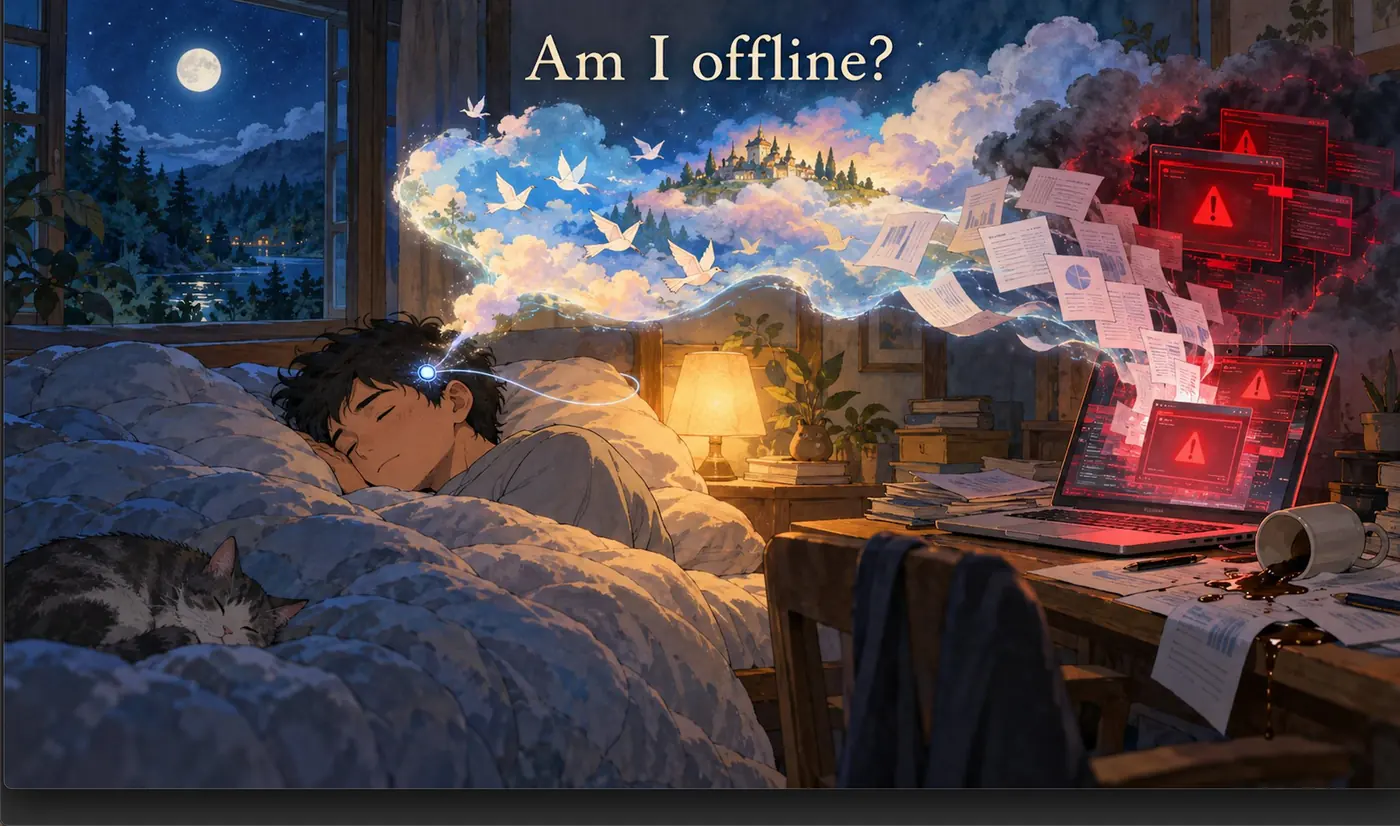
The screen displays an error message. I try a command; things get worse. More messages, just as alarming, scroll by rapidly. I start to panic.
Whatever I do, I feel like I’m breaking something.
I lose track of the time that passes between each attempt and each failure.
Then my vision goes completely dark… even though my eyes are open.
I’m in my room.
The first question that comes to mind is: “Am I offline?”
Then: “Did all of this happen only in my head, without changing anything in reality?”
I realize I’m fully back in the real world, and I think to myself that Nature built us in such a way that what happens inside our heads — especially when we dream — leaves us “offline,” completely disconnected from the world.
But for how much longer?
Cybernetic implants grafted onto the brain to compensate for a disability will one day be standardized. The same implants, used this time to gain productivity, are probably already at the stage of concrete experiments — or worse: wars unfortunately serve as pretexts to develop and deploy these technologies, even as prototypes, directly in the field.
The question then arises: will these implants need to remain functional while we sleep? If so, we will no longer truly be “offline.” Whatever comes out of our heads — even in the form of a dream — will have an impact, probably negative, on our environment.
Nature imposes needs on us, biological necessities for survival. It also offers ways to circumvent them: pills to delay sleep, or simply caffeine.
If we already know how to leverage Nature to create objects that satisfy or divert these necessities, should we imagine that one day sleep itself will become another moment in our daily cycle meant for producing, for creating value — in other words, for working?