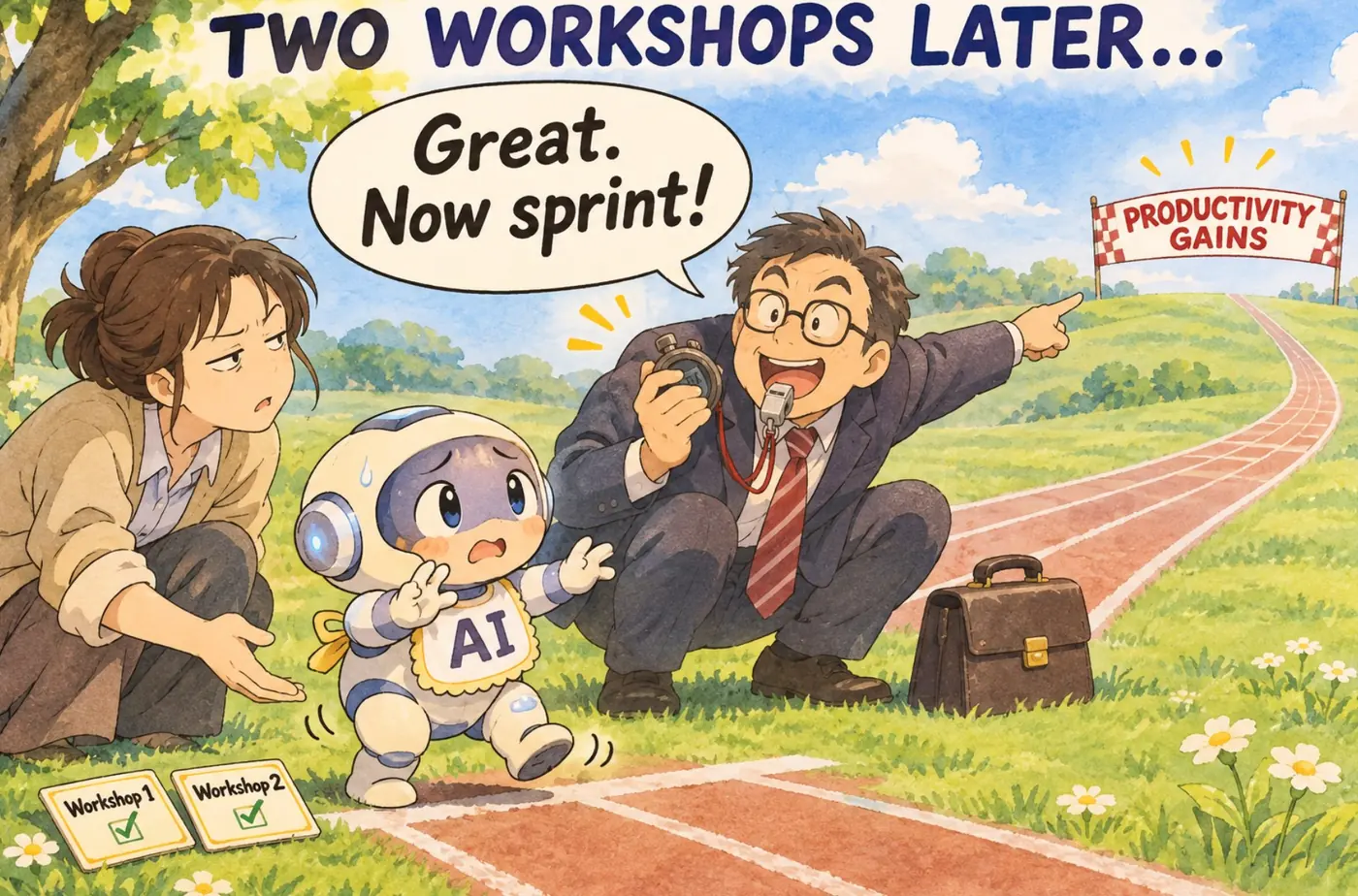
Asking long-time users of complex internal systems — ERPs, core banking, claims platforms — to test AI tools and report productivity gains after one or two workshops produces noise.
These users know the current process deeply. They are rarely positioned to redesign it.
Value creation is put to the wrong audience
ERPs and automation were not designed by asking every end user “how would automation make you more productive?” Users had a critical role in surfacing pain, exceptions, and failure modes. They did not own the system architecture, the process redesign, or the decision on how much control to retain. Treating them as the primary architects of transformation produces local optimisations and missed systemic gains.
Three groups, three jobs
- Users diagnose friction, volume, exceptions, and quality issues. They are excellent sensors.
- Process and risk owners decide what must stay human, what can be assisted, and what can be automated under which controls.
- Leaders with P&L or operating accountability choose the degree of change the organisation will actually absorb and fund.
Asking only the first group produces anecdotes. Asking only the third produces paper strategies. The value sits in the structured interaction between them.
Do not confuse training with transformation
A minimum level of hands-on capability is necessary. Just as organisations train people on Excel, they will need to train them on AI tools. The distribution of power users versus casual users will look similar to traditional office software.
Creating the ability to use a tool and redesigning the work are separate workstreams with different owners, timelines, and success criteria. Conflating them is how companies declare victory after a workshop series while the underlying processes remain unchanged.
Execute the brilliant basics by articulating the right problem statement. Only after that should an organisation decide which tools to buy or build, which steps to automate, which decisions stay human, and what training is required to make the new design work.
The inverse — starting with tools and looking for problems — produces activity without impact.