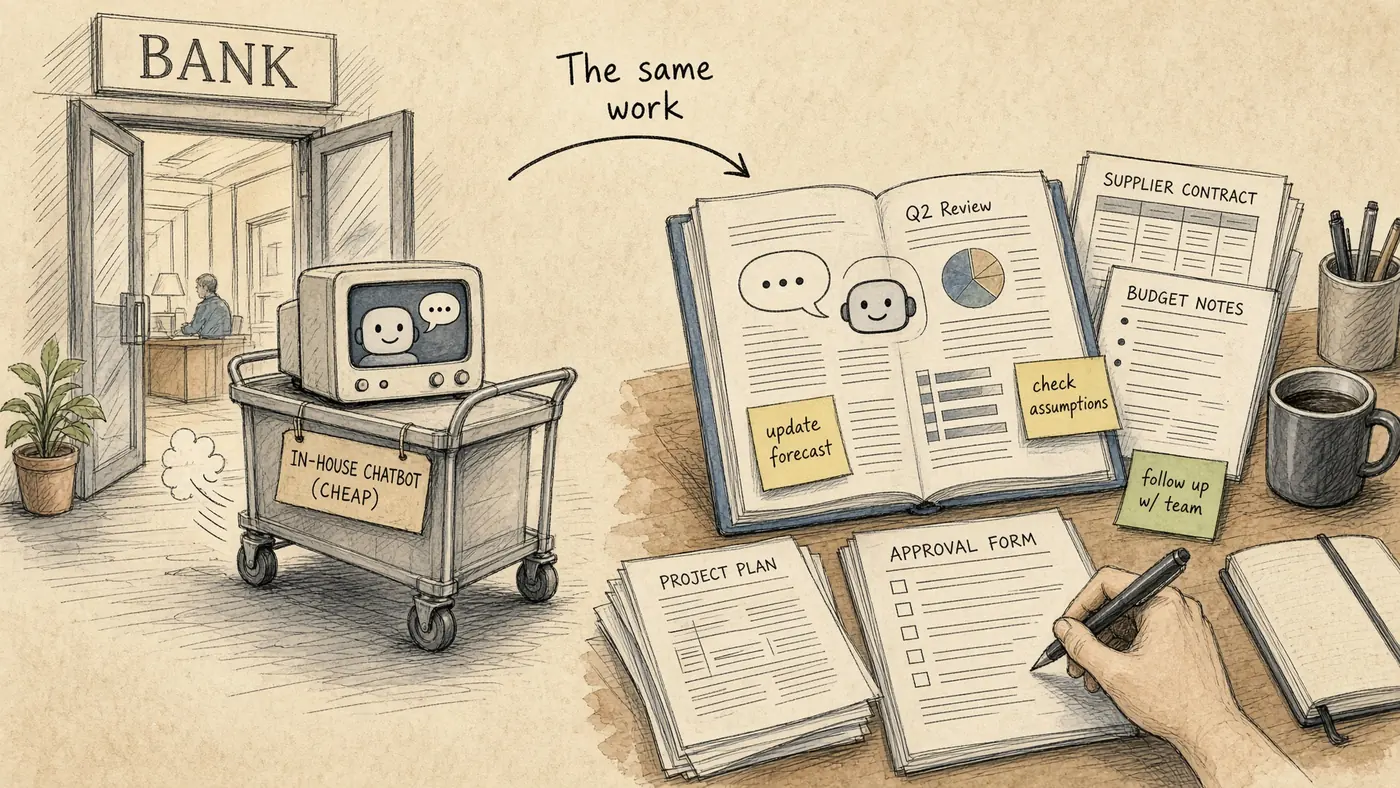
Société Générale has reportedly decided to decommission its internal ChatGPT clone.
Over the past three years, many firms — especially in finance — started with lightweight ChatGPT clones built on APIs. The economics can look compelling at first: about $500,000 to get something live, versus tens of millions a year for enterprise-wide licensing at thirty dollars a seat across something like a hundred thousand employees. That was phase one.
So why scrap a cheap clone, even if it works?
The real cost is industrialization
A low-friction clone can be cheap to launch. At a hundred thousand users in a regulated bank, the operational burden compounds: incident response, investigations of who accessed what, audit trails, retention, legal hold, security controls, monitoring, training, support. Even if you freeze features, you do not freeze obligations. “Keep it running and compliant” becomes a full product.
The suite moved the goalposts
Once Microsoft 365 or Google Workspace is the default work surface, value shifts from standalone chat to assistance in context: inside Word, Excel, PowerPoint, Outlook, and Teams, with permissions inherited from the files people already use, plus search and meeting summaries. A chat clone then competes with something embedded where employees already work. Even if model quality is similar, distribution wins.
The AI tax becomes unavoidable
Microsoft, Google, and the other incumbents are bundling AI into the core suites — less optional, more default. Why keep paying to operate a parallel service you will effectively have anyway?
Sovereignty is not the same as training a frontier model
Banks build domain models — fraud, AML, risk scoring — and sometimes fine-tune smaller models for narrow workflows. They care about data flows, regions, subprocessors, key management, retention, and private connectors. Training frontier models from scratch is rarely the job.
Without deep embedding into the Microsoft or Google work surface, or a work surface of their own, OpenAI and Anthropic risk becoming a premium add-on for advanced workflows rather than the default for the whole workforce. That leaves two questions. Do they need an Office-layer distribution play, possibly through an open-source productivity suite? And with the Microsoft–OpenAI ties, does the antitrust question heat up?