I have never seen a no-code or low-code platform that can truly replace real code for genuinely complex systems.
We are closer than we were ten years ago, but one stubborn reality remains: the cost of understanding, evolving, and governing a large software artifact at scale still requires serious engineering skill and discipline.
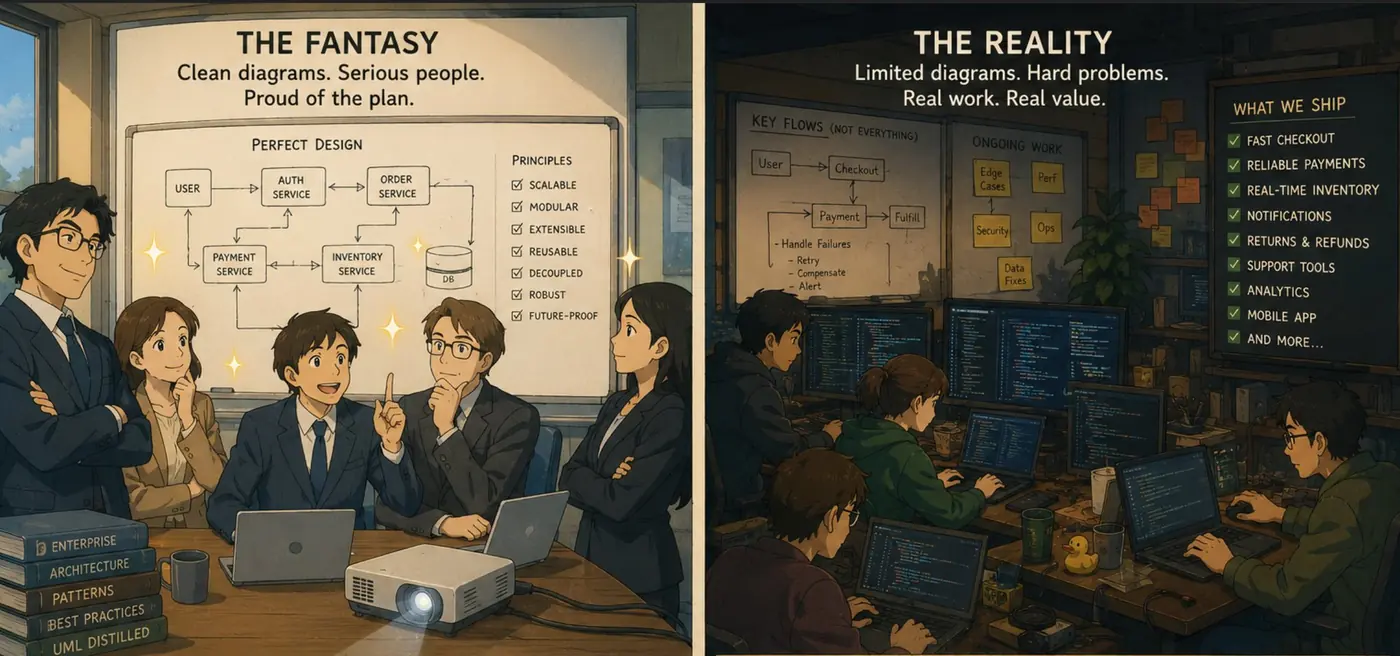
The fantasy of fully specifying software without code is ancient. The Gang of Four era turned UML into near-religious practice: model first, code later. In theory it promised clarity and reuse. In practice, outside of database schemas (where the model is executable), those diagrams almost always became either superficial illustrations or expensive liabilities that diverged from reality the moment implementation began.
High-level diagrams can usefully sketch primary flows and occasionally follow standards. They are, however, almost always incomplete snapshots of intent rather than authoritative specifications. They are cheap to produce when someone is motivated and expensive to maintain when reality shifts.
In environments that demand deep governance, that friction is only justified if the payoff in auditability or onboarding is massive. In most cases, the code itself remains the single source of truth precisely because it is executable, testable, and versioned.
We have already raised the abstraction level many times. We no longer write processor instructions by hand. We trust compilers, runtimes, frameworks, and libraries. The next layer — visual builders, executable models, or AI-generated systems — has to deliver the same combination of power, observability, and control that code currently provides.
The decisive variable is the required level of governance. In safety-critical, heavily regulated, or long-lived systems, you may need explicit traceability, formal properties, or generated artifacts with full audit trails. In those contexts, investing in stronger modeling or constrained languages can make sense.
For the majority of commercial software, the pragmatic answer remains the same: well-structured code, comprehensive automated tests, clear architectural decision records, ruthless review, and continuous integration deliver sufficient governance at lower long-term cost than heavyweight modeling.
The future, already here, is less code written by hand. Engineers work one level up, with an AI copilot and tools that keep intent and implementation in sync.
But code remains both the means of production and the ultimate artifact we must govern.